
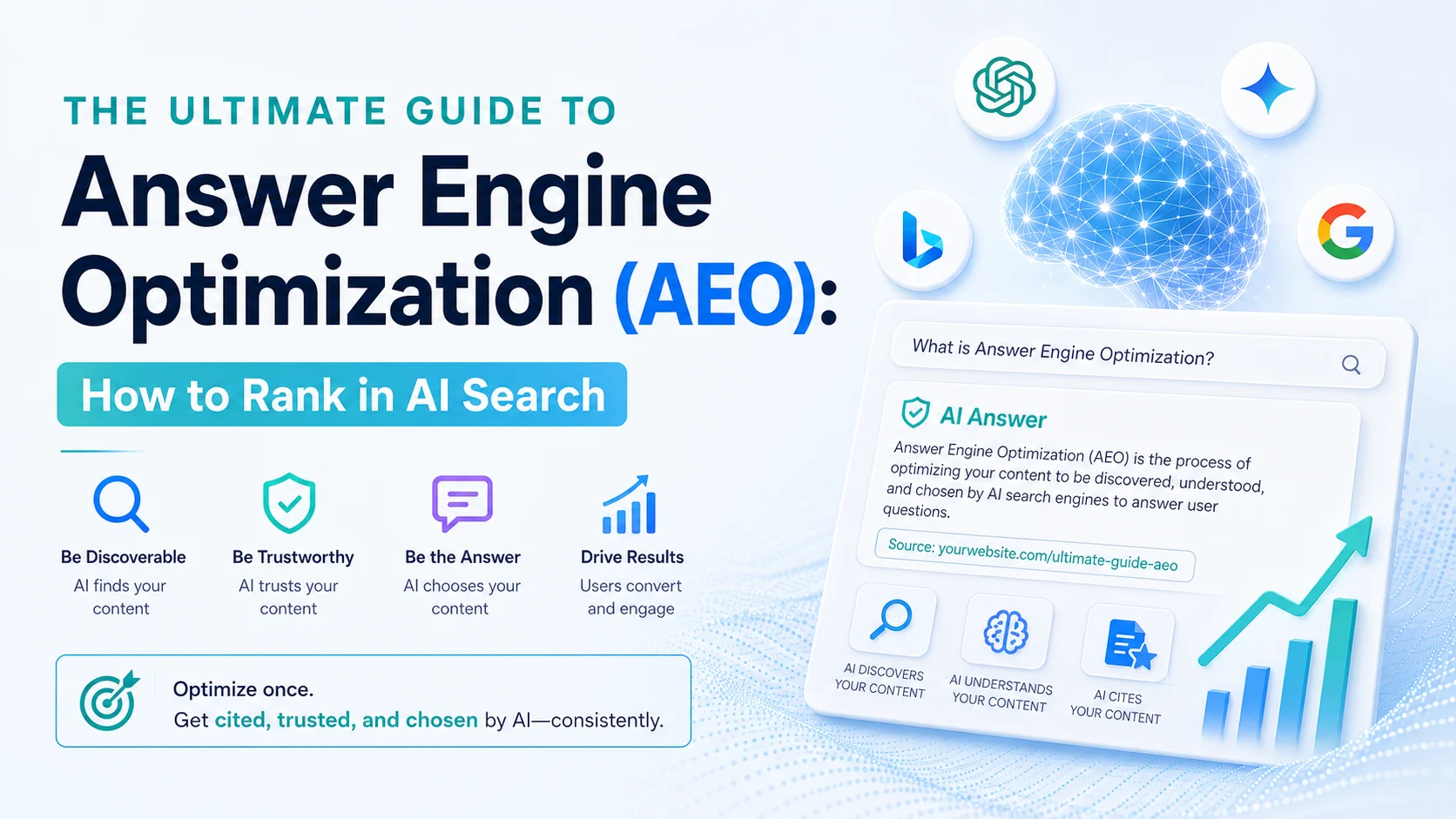
Answer engine optimization is the practice of making your website easy for search and AI systems to discover, understand, trust, extract, and cite when they generate direct answers. It combines traditional SEO, clear information architecture, expert-led content, appropriate structured data, technical accessibility, and measurement across AI-powered search experiences.
Ranking in AI search is not about finding a secret prompt, adding an “AI schema,” or creating hundreds of pages that repeat similar questions. The strongest strategy is to publish distinctive, well-supported information on a technically accessible website, organize it around genuine user needs, make important answers easy to locate, and build enough topical and brand authority that answer systems can confidently use your pages as sources. appropriate structured data, technical accessibility, and measurement across AI-powered search experiences.
Table of Contents
ToggleAnswer engine optimization is a content and technical strategy designed to increase the likelihood that a brand, website, or page will be used in direct answers generated by search engines and AI assistants.
Traditional search results often ask users to choose among several links. Answer engines may instead synthesize information from multiple sources, present a direct response, and attach citations or supporting links.
The objective is therefore broader than securing a single blue-link position. You want your information to be:
Google describes answer engine optimization and generative engine optimization as industry terms for work focused on visibility in AI search. From Google Search’s perspective, these practices remain part of SEO rather than a replacement for it. Google Search Central explains its current AI-search guidance here.
That distinction matters. Answer engine optimization adds new research, content-formatting, entity, citation, and measurement concerns, but it does not remove the need for technical SEO, useful content, internal linking, authority building, or conversion-focused design.
For a detailed comparison, see AEO vs. SEO vs. GEO.
Search behavior is becoming more conversational and task-oriented. People ask complete questions, request comparisons, seek recommendations, and expect synthesized guidance rather than a collection of loosely related results.
Google’s AI Overviews and AI Mode can use query fan-out, issuing multiple related searches across subtopics and data sources before assembling a response. This can create opportunities for websites to appear as supporting sources even when they are not the only page addressing the original question. Google documents how its AI features use supporting links and related searches.
Microsoft has also introduced AI citation reporting in Bing Webmaster Tools. Its AI Performance dashboard can report total citations, cited pages, grounding queries, URL-level citation activity, and visibility trends across supported Microsoft AI experiences. Review Microsoft’s AI Performance announcement.
A single user question may contain several hidden needs.
Someone asking, “What is the best CRM for a small property management company?” may also require information about:
A well-developed topical cluster can provide useful passages for several of these subtopics. This increases the number of relevant retrieval paths through which a brand may be discovered.
An AI-generated answer may introduce a company before the user searches for that company by name.
This can move brand discovery higher in the funnel. The first exposure may not always produce an immediate click, but it can influence:
Users who click a citation after reading an AI summary often want something the summary cannot fully provide.
They may need:
The destination page must continue the journey rather than merely repeat the generated answer.
Generic summaries are easy to reproduce. The following assets are much harder to commoditize:
Google’s current guidance emphasizes non-commodity, expert-led content that provides value beyond common knowledge. It also warns against producing large numbers of pages for minor query variations simply to manipulate traditional or generative search results.
Map the questions your prospects ask, connect them to existing pages, and identify where stronger evidence, clearer answers, or new supporting content is needed.
Focus on prioritized opportunities, not promises of guaranteed citations.
There is no universal ranking formula for every AI answer product.
Different systems may use different:
However, a practical working model contains six stages.
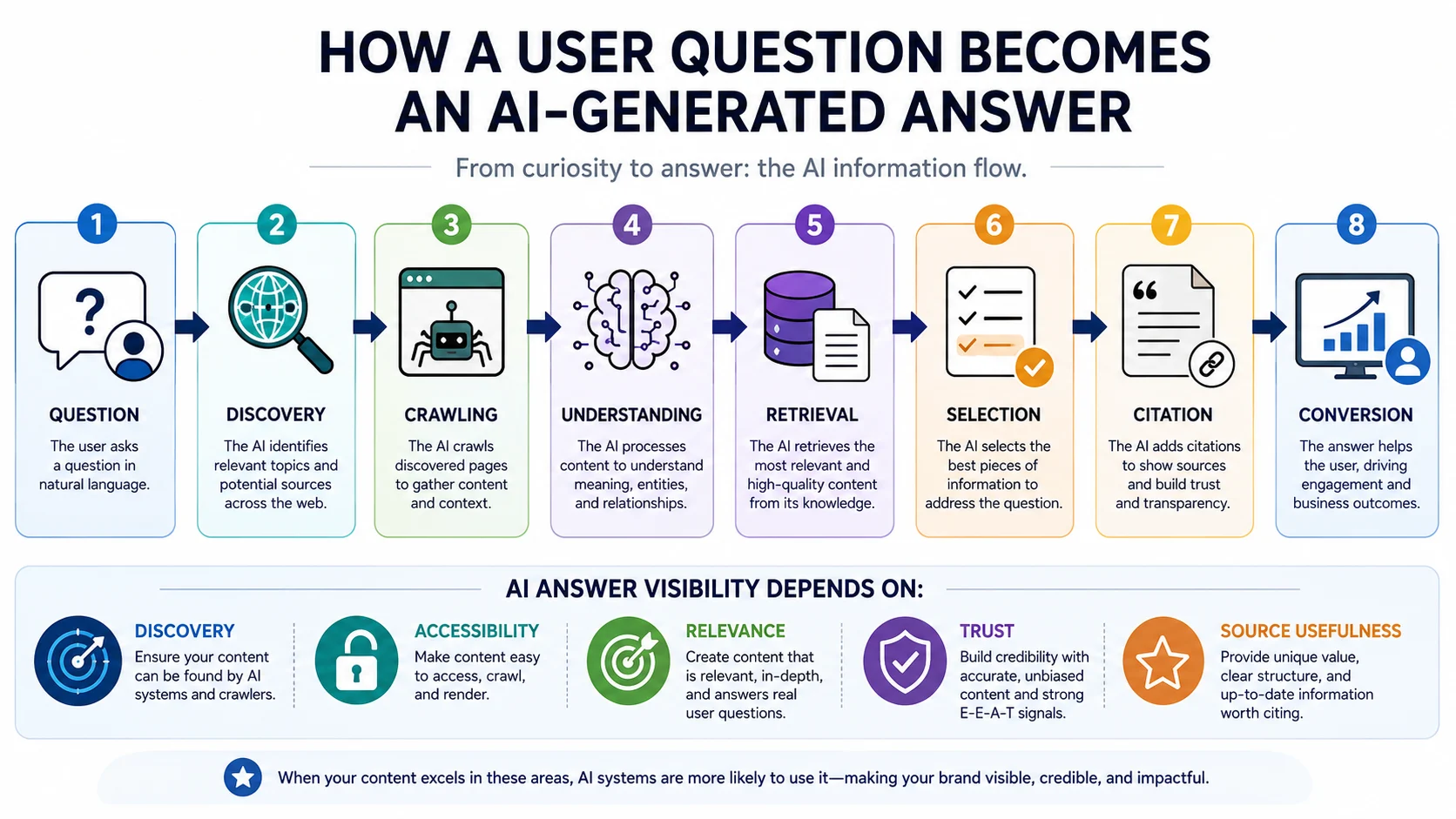
The system must first find the URL or information source.
Discovery may happen through:
For Google’s AI search features, a page must be indexed and eligible to appear in Google Search with a snippet. Google says there are no additional technical requirements for inclusion in AI Overviews or AI Mode.
OpenAI states that public websites can appear in ChatGPT search and advises publishers not to block OAI-SearchBot when they want their content included in summaries and snippets. Review OpenAI’s publisher and developer FAQ.
A crawler or retrieval system must be able to access the useful content.
Common barriers include:
A page can be editorially excellent but operationally invisible.
Crawl logs, URL inspection tools, rendered HTML, HTTP responses, CDN settings, and security rules should therefore be included in an answer engine optimization audit.
The system must identify:
Clear titles, descriptive headings, concise definitions, semantic HTML, accurate internal links, and consistent terminology reduce ambiguity.
Understanding does not require dividing every article into tiny fragments. Google explicitly says there is no requirement to “chunk” content into small pieces for generative AI and that no ideal page length applies to every subject.
For a specific question, a system may retrieve pages or passages that match both the explicit request and its implied subquestions.
A page about enterprise CRM pricing may be useful for questions about:
The page does not have to repeat every possible long-tail query. It needs to cover the underlying concepts clearly.
The system may compare several candidate sources.
Potential differentiators include:
No single factor guarantees selection.
The practical objective is to reduce reasons for exclusion while increasing the usefulness of the page as a source.
An answer may display a:
Answer engine optimization is incomplete when it focuses only on citations.
The destination page must continue the journey with:
SEO, AEO, and GEO overlap, but they emphasize different outcomes.
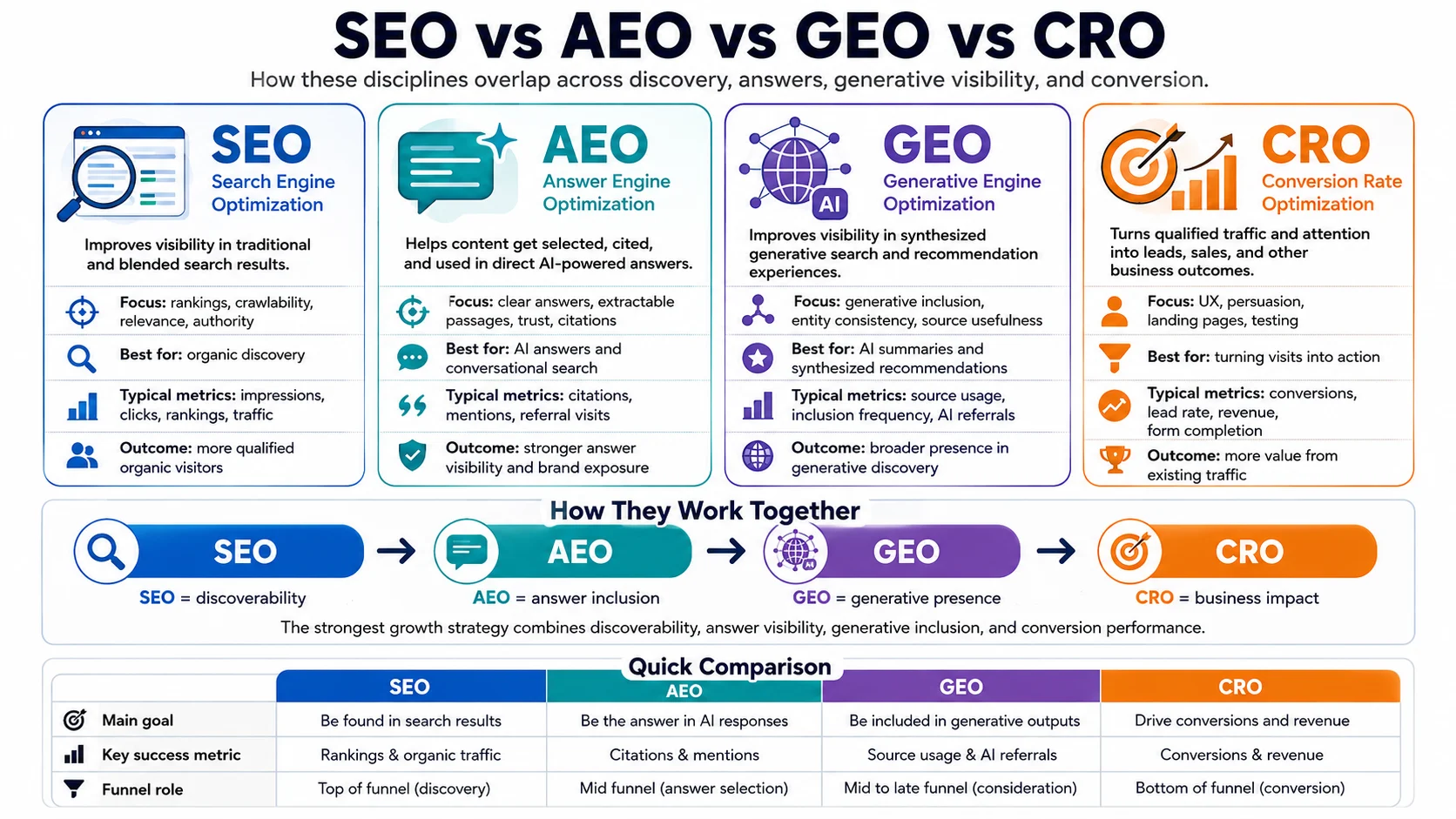
| Discipline | Primary focus | Typical outcomes |
|---|---|---|
| SEO | Organic visibility across search experiences | Rankings, impressions, clicks, conversions |
| AEO | Selection in direct and conversational answers | Citations, mentions, answer inclusion, referral visits |
| GEO | Visibility in synthesized generative experiences | Source usage, citations, brand representation, AI referrals |
| CRO | Turning qualified attention into outcomes | Leads, sales, sign-ups, assisted conversions |
The most practical approach is not to operate four disconnected programs.
A page that is blocked from crawling, poorly connected to the rest of the site, unsupported by evidence, or weakly matched to intent will not become a strong source merely because its headings are phrased as questions.
A sustainable program rests on seven foundations.
Research questions real customers ask before, during, and after a decision.
Useful sources include:
Group questions by intent rather than superficial keyword similarity.
For example, these questions may belong on one page:
These probably require separate supporting pages:
The first group shares definition-and-comparison intent. The second group represents implementation, platform evaluation, pricing, and measurement.
| Question | Intent | Audience stage | Best page type | Desired next action |
|---|---|---|---|---|
| What is AEO? | Learn | Awareness | Pillar guide | Read an implementation guide |
| How do I audit AEO? | Implement | Consideration | Tutorial | Download a checklist |
| Which platform should I use? | Compare | Evaluation | Comparison page | Start a trial or request a demo |
| How much does it cost? | Budget | Decision | Pricing guide | Book a consultation |
This prevents a common problem: publishing informational content that attracts attention but provides no logical path toward a useful or commercial outcome.
A topical map organizes pages around entities, subtopics, problems, and user journeys.
A strong answer engine optimization cluster may include the following pages.
Each page should own a distinct search intent. Internal links should clarify relationships among pages rather than simply repeating exact-match anchors.
A generic definition may establish relevance, but it rarely creates a durable advantage.
Strengthen content with:
Consider the difference between these examples.
- Use clear headings because AI systems prefer structured content.
- Commodity statement
- We compared 50 cited and 50 uncited pages in our market, classified their heading patterns, and found that cited pages answered the primary question earlier. Here is the methodology, dataset, and list of exceptions.
- More useful and defensible statement
The second version gives readers and answer systems something distinct to reference.
Expertise should be demonstrated rather than claimed.
Add:
Google recommends making the “Who, How, and Why” of content clear. This includes transparent authorship and explanations of how automated or AI-assisted content was produced when that context would matter to readers. Review Google’s people-first content guidance.
For mixed-audience content, expertise also requires separating business implications from technical instructions.
A business owner needs to understand why crawler access matters. A developer needs to know which user agent, response code, firewall rule, or rendering problem to inspect.
Important sections should answer their headings immediately.
Use this sequence:
Does schema markup improve AI visibility?
Structured data can help search systems interpret page entities and may make a page eligible for supported rich-result features, but it is not a guaranteed AI-ranking mechanism. Use accurate markup that matches visible content, validate it, and treat it as one component of a broader technical and editorial strategy.
This format helps readers scan the article and allows retrieval systems to identify a self-contained passage without stripping away essential context.
Microsoft’s publisher guidance recommends clear headings, tables, supporting evidence, freshness, and consistent entities across text, images, and video to make information easier to reference accurately.
An entity may be a:
Keep important information consistent across:
For organizations, publish accurate details such as:
Consistency does not mean repeating one marketing sentence everywhere. It means avoiding conflicting facts and making relationships among entities easy to verify.
Self-published claims are useful, but independent corroboration may strengthen confidence.
Relevant signals can include:
Do not manufacture mentions, create fake reviews, or mass-produce low-quality guest posts.
The strongest content structure serves human comprehension first.
Answer the primary question before providing history or broad context.
A heading should indicate what the section resolves.
| Prefer | Avoid |
|---|---|
| How AEO Works | Overview |
| Technical Requirements for AI Search | More Details |
| How to Measure AI Citations | Additional Information |
A paragraph should not depend on multiple earlier pronouns or unexplained references.
This helps it understand them better.
Weak
Descriptive internal-link anchors help search and AI systems understand the relationship between the source page, destination page, and subject.
Clearer
Self-contained does not mean repetitive. Include enough context for the passage to remain accurate when quoted or summarized.
Lists work well for audit steps, eligibility checks, decision criteria, benefits, mistakes, and required page elements.
Do not turn every paragraph into a bullet. Narrative explanation remains necessary for nuance, transitions, and persuasion.
Tables are useful for tools and capabilities, schema types, audit priorities, content formats, measurement frameworks, and comparisons such as SEO vs. AEO vs. GEO.
Keep tables narrow enough for mobile devices and explain the main conclusion after each table.
A short “In brief” statement can help readers understand the conclusion before exploring the evidence.
Do not repeat the same response in the introduction, key takeaway, every main section, FAQs, and conclusion.
There is no universal article length. Google explicitly says pages can be shorter or longer depending on the audience and subject, and that there is no ideal page length for generative AI search.
Write until readers can complete the intended task or make the intended decision.
Technical SEO establishes eligibility and access. It does not guarantee citation, but technical failures can eliminate otherwise excellent content from consideration.
Check that:
OpenAI distinguishes between its search crawler and model-training crawler.
Publishers that want inclusion in ChatGPT search summaries should allow OAI-SearchBot. Publishers can separately control GPTBot for potential training use.
User-agent: OAI-SearchBot
Allow: /
Do not paste crawler rules into production without reviewing your:
Search visibility and model-training permissions are separate governance decisions.
Include canonical and indexable URLs. Use accurate last-modified dates only when meaningful page content has changed.
Bing recommends combining comprehensive XML sitemap coverage with IndexNow notifications for URLs that have been added, updated, or removed.
Do not:
lastmod date each time the sitemap is generated.IndexNow notifies participating search engines when URLs change.
It does not guarantee crawling, indexing, rankings, or AI citations. However, it can reduce the delay between a meaningful update and discovery by participating systems.
It is particularly useful for:
Do not assume every crawler executes an application exactly as a modern browser does.
For important content and links:
href attributes.Semantic HTML and accessibility help both users and automated systems interpret page structure.
Use:
OpenAI’s publisher and developer guidance notes that its browser agent uses accessibility information, including ARIA labels and roles, to interpret interactive page elements.
Structured data provides explicit, machine-readable information about a page and the entities it contains.
Useful schema types may include:
Use the most specific supported type that accurately represents the visible page.
Google states that there is no special schema required for AI Overviews or AI Mode. It also says structured data should match the visible text of the page.
Google may reject or ignore markup when it:
For implementation details, see schema markup for AI search.
Topical authority is not achieved by publishing the largest possible number of pages.
It comes from covering a subject coherently, demonstrating expertise, and connecting related information in a way that serves distinct audience needs.
For this guide, the central entity is answer engine optimization.
Related entities include:
Assign one primary intent to each URL.
A pillar page may explain the complete subject. A supporting article may cover one implementation problem. A commercial page may explain a service, product, or platform.
Do not publish five pages that all answer “What is AEO?” using slightly different titles.
A Complete AEO Content Cluster Might Include:
Each supporting article should link back to the pillar and laterally to closely related resources.
When two pages satisfy the same intent:
Duplicate and near-duplicate pages can blur intent and split useful signals.
Do not begin by rewriting every page.
Prioritize URLs that already have authority, impressions, links, conversions, rankings, or strategic relevance.
Look for pages that:
Compare the page with current search and customer needs.
Ask:
Review and revise:
Do not simply add more words.
Add something competing summaries cannot easily reproduce:
Add or update:
Inspect:
Match the CTA to the reader’s stage.
For an educational guide, useful next steps may include:
The CTA should extend the answer rather than interrupt it.
Use a structured audit to identify which pages need stronger openings, clearer entities, better evidence, technical fixes, or more useful conversion paths.
Use the checklist to prioritize improvements by impact and effort.
Traditional rankings remain useful, but they do not fully describe AI visibility.
Use a measurement framework with five layers.
Bing Webmaster Tools’ AI Performance reporting can provide citation counts, cited pages, grounding queries, and URL-level trends for supported Microsoft AI experiences.
Use the current reports available in each verified platform rather than relying on a third-party product that claims to reproduce private ranking systems or unavailable platform data.
OpenAI adds utm_source=chatgpt.com to referral URLs from ChatGPT search, allowing those visits to be identified in analytics.
Visibility is not automatically positive.
Review:
Connect AI visibility to:
| Category | Metric | Example baseline | Example target | Review cycle |
|---|---|---|---|---|
| Technical | Indexable strategic pages | 82% | 98% | Monthly |
| Visibility | Cited URLs | 14 | 30 | Monthly |
| Coverage | Tracked questions with citations | 9% | 20% | Monthly |
| Referral | AI referral sessions | 400 | 800 | Monthly |
| Conversion | Qualified AI referral leads | 12 | 25 | Monthly |
| Quality | Accurate sampled brand answers | 76% | 95% |
Quarterly |
These numbers are examples, not universal benchmarks.
Set targets according to your:
There is no guaranteed heading formula, schema type, machine-readable file, keyword pattern, prompt, or word count.
Google says there is no need for special AI markup, artificial content chunking, unnecessary AI text files, or content rewritten solely for generative systems.
This creates:
Create separate pages only when the intent, audience, format, or required decision changes materially.
A page that only restates common knowledge gives an answer system little reason to cite it over stronger sources.
Add:
Check robots.txt, noindex directives, canonicals, CDN rules, WAF blocks, server logs, rendered HTML, and HTTP responses.
FAQs are valuable when they resolve genuine follow-up questions. Repetitive question blocks do not automatically improve visibility and may make a page feel manufactured.
Markup must match visible content and comply with platform guidelines. Invalid or misleading structured data can lose eligibility for supported search features.
A citation that sends no qualified traffic or produces no measurable business effect may still have awareness value. It should not, however, be reported as equivalent to a lead, sale, or conversion.
Update content when facts, products, prices, regulations, platform interfaces, tools, policies, or recommendations change.
Do not change publication dates without meaningful revisions.
The final test is whether the page helps someone complete a task, understand a subject, compare options, make a better decision, or take an appropriate next step.
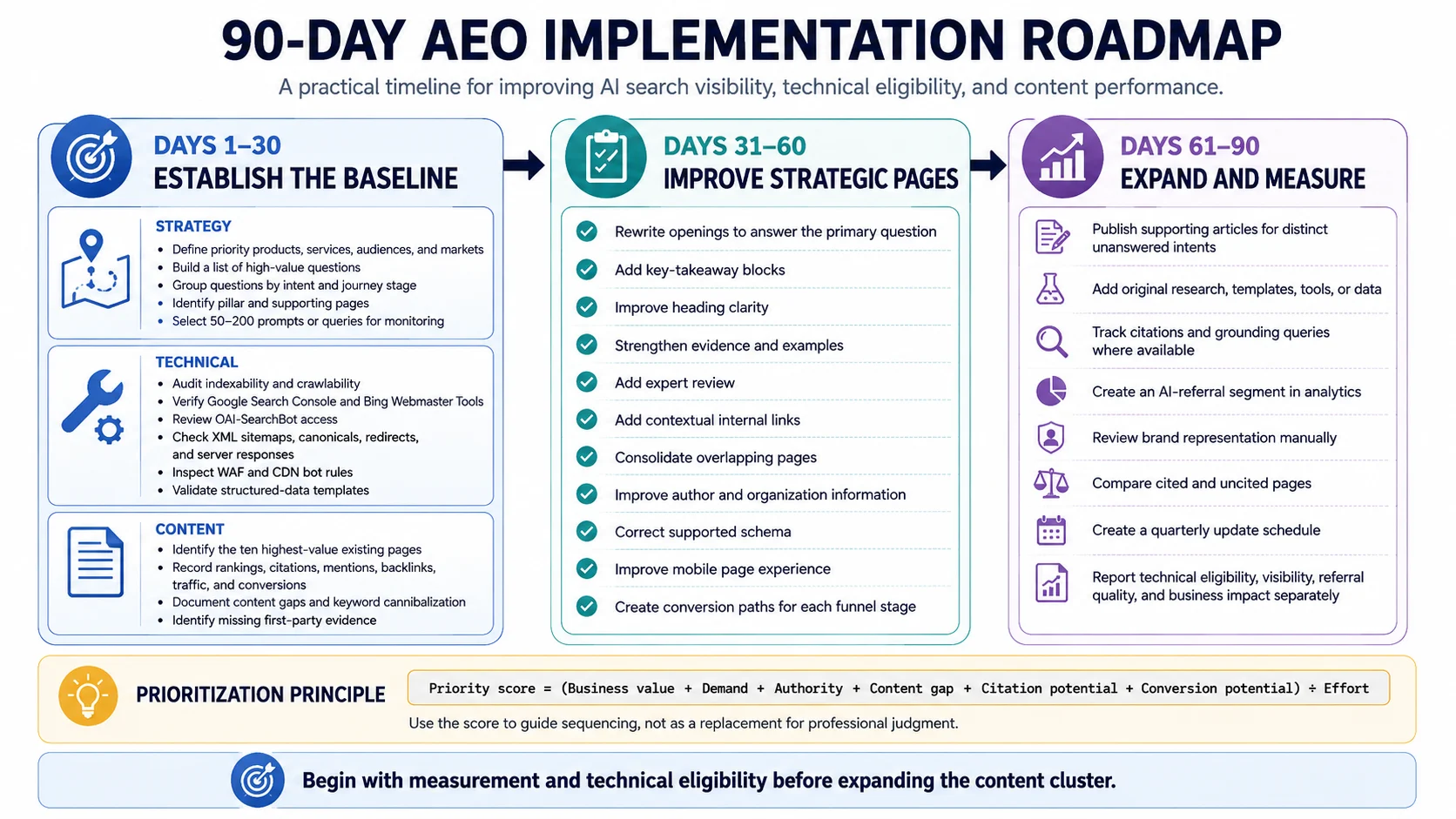
Score each opportunity from one to five for:
Priority score = (Business value + Demand + Authority + Content gap + Citation potential + Conversion potential) ÷ EffortUse the resulting score to guide sequencing, not as a replacement for professional judgment.
No. AEO is best treated as an extension of SEO for direct-answer and generative interfaces. Technical accessibility, indexing, content quality, links, entities, and user satisfaction still matter. The newer work adds question research, passage clarity, source usefulness, citation monitoring, and brand-representation analysis.
There is no fixed timeline. Technical changes may improve eligibility after crawling and processing, while content depth, authority, independent validation, and citation frequency may take longer to develop. Establish a baseline and evaluate trends across several reporting cycles rather than expecting immediate inclusion.
FAQs can help when they answer genuine follow-up questions clearly and provide information not already covered. They are not a guaranteed citation trigger or ranking factor. Use them for reader value, keep answers accurate, and avoid repeating the primary keyword unnaturally.
No. Structured data can clarify page meaning and support eligibility for certain search features, but no supported schema guarantees selection in an AI-generated answer. Google says no special schema is required for its AI features.
Not for Google Search. Google states that it ignores llms.txt and that the file neither helps nor harms visibility in Google Search. Other services may choose to use such files, so evaluate the requirement platform by platform rather than treating it as universal.
Publish useful public content and avoid blocking OAI-SearchBot when inclusion is desired. Also ensure that security systems, CDN settings, authentication, and rendering do not prevent crawler access. OpenAI notes that public websites can appear and that resulting referral traffic can be identified in analytics.
The right toolset depends on the task.
No third-party tool can guarantee citations or access the private ranking systems of major search platforms. See the planned AEO tools comparison for a task-based evaluation framework.
Update content when underlying facts, interfaces, products, prices, regulations, examples, or recommendations change. High-volatility topics may require frequent review. Evergreen definitions may require only periodic validation. Meaningful accuracy matters more than changing the displayed date.
Yes, particularly for narrow expertise, local questions, specialized services, original experience, and specific customer problems. A small website may not cover an entire broad field, but it can become a strong source for a clearly defined market, process, location, service, or entity.
Pricing varies by scope. A technical audit, content program, entity strategy, citation-monitoring system, and enterprise implementation require different resources. Evaluate the actual deliverables, platforms covered, query volume, technical support, content production, reporting, and integration requirements rather than purchasing a vague promise to “rank in AI.”
For a buying framework, see the planned AEO pricing guide.
Effective answer engine optimization starts with a straightforward principle: become the clearest, most useful, technically accessible, and verifiably trustworthy source for the questions that matter to your audience.
Build the technical foundation first.
Then:
Do not chase every new tactic.
Platform interfaces, crawlers, and reporting features will continue to evolve. A durable strategy is based on content people value, information systems can interpret, evidence others can verify, and website experiences that turn discovery into a productive next step.
Audit your priority pages, crawler access, topical gaps, and current citations to identify the improvements most likely to strengthen search visibility and qualified conversions.
Receive a prioritized action plan—not a guarantee of rankings or citations.